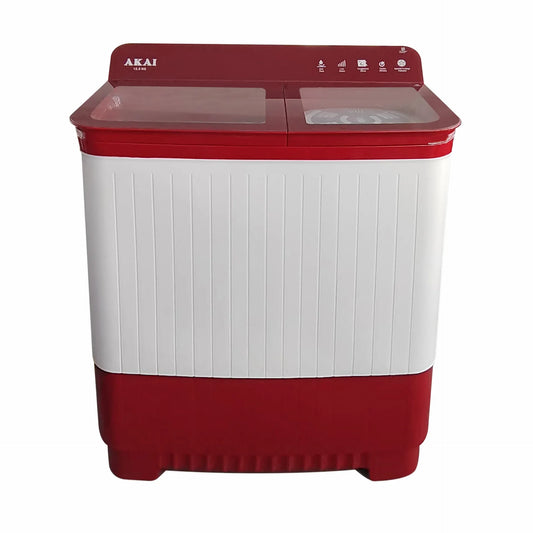
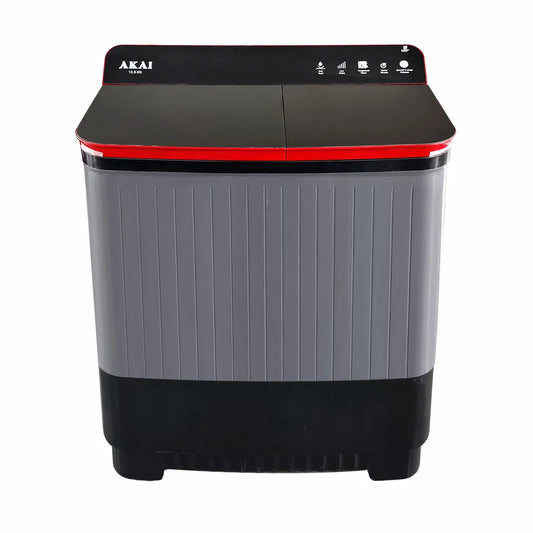
Handle Larger Laundry Loads with Our 12.5 Kg Washing Machines
At AKAI India, we understand that laundry requirements can change significantly in a large or busy household. Frequent clothing changes, school uniforms, towels, bedsheets and seasonal fabrics can quickly create loads that feel restrictive in a smaller machine. We offer our 12.5 kg semi-automatic washing machines for customers who want generous wash capacity together with direct control over water filling, washing, rinsing and spin extraction.
Our current collection includes two semi-automatic top-load models: AKSA-125DGBFG in Dark Grey and AKSA-125DRTG in Red. Both belong to the same 12.5 kg capacity class. If their approved technical specifications are identical, your decision can focus on finish, live availability and current offer. If any motor, lid, tub, programme or accessory differs, refer to the comparison table and individual product specification before ordering.
Capacity should be chosen for your real laundry pattern rather than household size alone. A 12.5 kg machine can be relevant for a large family, a household that washes less frequently, or users who regularly handle high-volume laundry. However, it may be unnecessarily large for customers who wash small loads every day. Available floor space, water requirement, drain access and the separate spin-tub limit also matter.
Who Should Choose a 12.5 Kg Washing Machine?
We recommend considering this capacity when one or more of these conditions apply:
- Your household regularly accumulates large clothing loads;
- Several family members share the same laundry schedule;
- You want to reduce the need to divide a large wash into many small batches;
- You frequently wash towels, bedsheets or other bulky items permitted by the care label and appliance manual;
- You prefer a semi-automatic machine because water supply is irregular or you want manual water control;
- You have enough floor and movement space for a large twin-tub body.
The phrase `for large families` is useful guidance, not an exact capacity rule. The number of garments depends on fabric type, size, thickness and moisture. Heavy cottons occupy capacity differently from light synthetic clothing. Never compress garments into the tub merely to reach the rated number.
If your laundry is usually modest, compare our lower-capacity semi-automatic models before choosing. The right machine is the one you can load, fill, drain and operate comfortably, not automatically the largest model available.
What Does 12.5 Kg Capacity Actually Mean?
The stated capacity normally refers to the maximum dry-clothes load for the wash tub under specified conditions. It is not a promise that every combination of garments weighing 12.5 kg can be washed together. Garment-care labels, fabric bulk, water level and load balance remain important.
A semi-automatic twin-tub machine also has a separate spin tub. Its rated spin capacity may be lower than its wash capacity. You may therefore need to transfer a washed load into the spin tub in more than one balanced batch. AKAI should publish both ratings prominently for each model. Until that information is verified, do not assume `12.5 kg wash` means `12.5 kg spin`.
For bulky items, check the approved user manual. A high capacity can provide more room, but not every quilt, blanket, curtain or rug is machine-washable. Weight after water absorption, material, stitching and care instructions determine whether an item is suitable.
How Our Semi-Automatic Twin-Tub Process Works
Our 12.5 kg collection uses semi-automatic operation. You control more of the process than you would with a fully automatic machine. A typical wash involves these steps:
- Place a suitable dry load in the wash tub.
- Add water and detergent according to the garment load and approved instructions.
- Select the appropriate wash programme and time.
- Drain and rinse as required.
- Transfer clothes manually to the separate spin tub.
- Balance the spin load, secure the inner cover where supplied and select the spin time.
The appliance does not transfer garments automatically between tubs. This manual workflow is an advantage for users who want direct control, but it is not the right choice for everyone. Customers who prefer a single-tub process with minimal handling should compare our fully automatic washing machines.
Why Manual Water Control Can Be Useful
Semi-automatic machines can work well in Indian homes where water pressure or supply timing is inconsistent. Because you add and manage water manually, you are not always dependent on a continuous pressurised inlet throughout an automated programme.
Manual control also lets you match water quantity to the load, provided you follow the operating instructions. Too little water can restrict garment movement and cleaning; excessive water can waste resources and exceed the safe level. Use the marked water levels and approved guidance rather than estimating blindly.
Water from a previous stage should be reused only when hygienically appropriate and permitted by the manual. Do not reuse visibly dirty water for garments that require hygienic washing, and do not make universal water-saving claims without a documented test method.
Powerful Water Movement with the 5-Wing Pulsator
The researched Dark Grey product page describes a special 5-wing pulsator. A pulsator moves water and garments through the wash tub to help detergent reach fabric surfaces and release everyday dirt. Effective cleaning still depends on appropriate loading, detergent dose, programme selection and stain pre-treatment.
Avoid overloading the tub. Garments need sufficient room to circulate. Separate delicate fabrics from heavy items, close zips, empty pockets and place small garments in an appropriate laundry bag where their care instructions allow it. Treat stubborn stains before washing rather than relying on a longer timer alone.
If the Red model uses the same pulsator, state this in its specification table. If it differs, explain the distinction instead of treating the products as colour duplicates.
Select the Right Wash Programme
AKAI 12.5 kg product has three wash programmes. Use a gentle setting for delicate or lightly soiled garments, a normal setting for routine mixed laundry, and a stronger setting only for compatible durable fabrics with heavier soil. Always follow garment-care labels. Stronger agitation is not appropriate for every fabric and should not be presented as automatically producing a better result.
For better results:
- Sort by colour, fabric and soil level;
- Do not mix lint-producing towels with lint-attracting dark garments;
- Pre-treat stains promptly;
- Use a machine-compatible detergent in the recommended quantity;
- Rinse thoroughly when required;
- Clean the lint filter after use.
Magic Filter and Lint Management
The 12 kg washing machine has a Magic Filter designed to collect lint released during washing. This can help limit loose fibres recirculating in the tub, but the filter needs regular cleaning to remain useful.
Remove collected lint after a wash or at the frequency stated in the manual. Refit the filter correctly before the next cycle. A lint filter does not replace sorting: towels, fleece and other lint-producing fabrics should still be separated from garments that attract visible fibres.
Dynamic Motor Protection and Heavy Loads
AKAI has a dynamic advanced motor with protection against overheating. Thermal protection is a safeguard; it should not be interpreted as permission to overload the machine or operate it continuously beyond the manual's limits.
For safe, consistent use, distribute garments evenly, observe the rated load, use stable power and allow any required rest interval between heavy cycles. If the motor stops due to protection, switch off the appliance and follow the troubleshooting instructions rather than repeatedly restarting it.
Before publication, display the verified wash-motor input, spin-motor input and applicable motor warranty. Competitors often publish wattage and RPM clearly, so missing data weakens both customer confidence and search relevance.
Faster Moisture Removal Through Spin Extraction
After washing and rinsing, the spin tub extracts water from garments. Higher effective spin performance can reduce residual moisture and shorten subsequent air-drying time, but it does not completely dry clothes.
Load the spin tub evenly and never force in the entire wash load if the verified spin capacity is lower. An unbalanced load can cause vibration, noise or ineffective spinning. Use the inner spin cover if supplied, close the lid and follow the approved timer limit.
Rust-Resistant Plastic Body and Tub
AKAI 12 kg washing machine has a plastic body and tub intended to resist corrosion. This can be practical in humid laundry areas, but `rust-resistant plastic body` is more precise than implying that every internal metal component is rust-proof.
Keep the machine ventilated, wipe away standing water, avoid direct rain and follow electrical-safety instructions. Do not leave the machine permanently filled after use.
Buzzer Alerts for Cycle Awareness
The buzzer provides an audible indication when a timed stage finishes. This is particularly useful in a semi-automatic process because the next step may require you to drain, rinse or transfer the load manually.
The buzzer is an alert, not proof that the entire laundry process is complete. Check the selected stage and follow the operating sequence before opening or transferring garments.
Castor Wheels and Safe Mobility
Integrated castors can help reposition a large machine for cleaning or drainage. Before moving it, switch off and unplug the appliance, drain both tubs, secure loose pipes and confirm that the route is dry and clear. Never pull the unit by the cable, inlet hose, drain hose or control panel.
During washing and spinning, position the machine on a stable, level surface. Castors are a mobility feature, not a reason to operate the appliance on a slope or unstable base.
12.5 Kg vs 10.5 Kg vs 8.5 Kg
Choose our 12.5 kg category when large or accumulated loads are a regular requirement and you have the necessary space. Consider 10.5 kg when you want more capacity than a standard family machine without moving to the largest body. Consider 8.5 kg when loads are more frequent and moderate, or laundry-space efficiency matters more than maximum capacity.
8.5 kg Capacity
- Best Starting Use Case: Regular medium-family laundry
- Check Before Choosing: Variant, tub material, and spin capacity
10.5 kg Capacity
- Best Starting Use Case: Larger mixed loads
- Check Before Choosing: Floor space, motor, and dimensions
12.5 kg Capacity
- Best Starting Use Case: High-volume or large-family laundry
- Check Before Choosing: Water, space, spin capacity, and manual handling
These are selection guidelines, not fixed family-size promises.
Semi-Automatic vs Fully Automatic for a Large Family
Choose our 12.5 kg semi-automatic models if you are comfortable adding water, draining and transferring clothes between tubs. They may suit homes with irregular water supply and customers who value direct control.
Choose a fully automatic washing machine if you want wash, rinse and spin stages completed in one tub with less intervention, and you have the required water inlet and drainage setup. A fully automatic model may offer more convenience, while a semi-automatic model offers greater involvement and flexibility. Neither format is universally better.
Space, Installation and Drainage Checklist
Before ordering, measure the installation area and route to it. Compare those measurements with verified product dimensions, including clearance needed to open both lids fully.
Confirm:
- A firm, level and dry floor;
- A safe earthed power socket within approved reach;
- Access to water filling;
- A suitable drain point below the permitted hose height;
- Ventilation around the unit;
- Enough room to transfer wet clothes safely;
- A doorway and passage wide enough for delivery.
Do not use an extension board unless explicitly approved. Keep the plug and control panel dry. Installation and electrical work should follow the manual and local safety requirements.
Detergent and Everyday Washing Guidance
Use a detergent suitable for top-load or semi-automatic washing machines and dose it according to the product instructions, water conditions, soil level and load. Too much detergent can create excessive foam and make rinsing harder; too little may reduce cleaning performance.
Empty pockets, secure hooks and zips, turn embellished garments inside out and use laundry bags where appropriate. Do not wash items contaminated with flammable substances. Follow individual garment-care labels and the approved appliance manual.
Care and Maintenance
To support consistent performance:
- Unplug the machine before maintenance;
- Drain both tubs after use;
- Clean the Magic Filter regularly;
- Wipe the body, lids and control panel with a soft cloth;
- Keep hoses free from sharp bends and blockages;
- Check pockets to prevent coins or objects entering the tubs;
- Leave lids open briefly after use when the manual permits, allowing moisture to dissipate;
- Do not use abrasive or corrosive cleaners;
- Contact authorised service for electrical, motor or internal repairs.
Publish downloadable manuals and spare-part guidance beside each model. Ownership information improves customer trust and can also make the page more useful to search engines and AI answer systems.