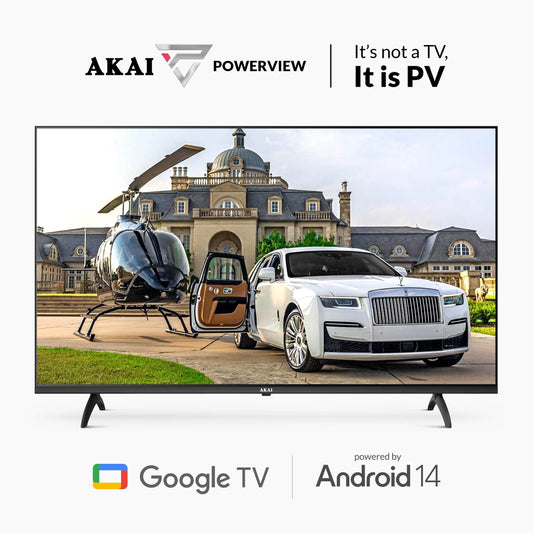
AKAI 50 Inch TV: Immersive 4K Entertainment for the Living Room
A 50 Inch TV is a practical choice for viewers who want a noticeably larger picture than a 43-inch screen without moving all the way to a 55-inch or 65-inch television. It can work especially well in a 2 BHK or 3 BHK living room, a family room or a larger bedroom where the normal seating distance is moderate. The 127 cm screen creates a more immersive experience for movies, sports, streaming and console gaming while remaining manageable for many Indian apartments.
AKAI’s current 50-inch range is built around 4K Ultra HD, QLED and Google TV positioning. The collection includes a standard AKAI 50-inch 4K QLED Google TV and a Power View model positioned with Android 14. Instead of choosing only by price or discount, compare the models using verified resolution, operating system, processor, RAM and storage, HDR support, native refresh rate, gaming inputs, sound formats, ports and warranty.
This guide explains the screen size, room fit, picture technology, streaming platform, connectivity and purchase checks that matter. Prices, ratings, stock and promotional offers can change, so the live product card and corrected specification table should be treated as the final source before ordering.
What Does a 50 Inch or 127 cm TV Mean?
A 50-inch television is commonly marketed as a 127 cm TV in India. The measurement refers to the screen diagonal—from one corner of the visible display to the opposite corner. It does not represent the width of the TV.
For a standard 16:9 display, the visible picture area is approximately 111 cm wide and 62 cm high. The complete product will be slightly larger because of the bezel, chassis and stand. Two TVs with the same 50-inch diagonal can have different total dimensions and different stand widths, so always check the exact measurements of the selected model.
Before buying, measure four things:
- The available wall or furniture width.
- The distance between the TV’s feet if using the stand.
- The normal distance from the screen to your eyes.
- Space for ventilation, power, HDMI and soundbar cables.
If wall mounting is planned, verify the VESA mounting pattern, product weight, wall material and bracket capacity. Also, check whether the bracket is included and what the installation service covers.
Is a 50 Inch TV Right for Your Room?
A practical starting viewing range for many 50-inch setups is approximately 6.5 to 9 feet. This is not an absolute rule. A viewer watching high-quality 4K content may prefer to sit closer, while compressed DTH channels or personal comfort may make a longer distance preferable.
The easiest test is to mark an area about 111 cm wide and 62 cm high on the intended wall using removable tape. Sit in your normal position and check whether the picture area feels balanced. This also helps you identify whether furniture, speakers or windows will interfere with the installation.1 BHK Living Room – Often suitable when the seating distance is moderate and the wall has enough width.
- 2 BHK Family Room – A strong mainstream size for movies, sports, OTT streaming, and DTH viewing.
- Large Bedroom – Suitable if the bed-to-screen distance is comfortable and the TV is mounted at the correct height.
- Small Bedroom – May feel large for the space; comparing it with a 43-inch TV can help determine the best fit.
- Large Living Room with Distant Seating – A 55-inch or 65-inch TV may provide a more immersive viewing experience.
Place the centre of the screen close to seated eye level where possible. Mounting a television too high can cause neck discomfort during long viewing sessions. Avoid placing the screen directly opposite an uncovered bright window; reflections can reduce perceived contrast even on a bright display.
Compare AKAI’s 50 Inch TV Options
AKAI 127 cm (50) 4K Ultra HD Smart Google QLED TV
This model is the value-positioned 50-inch option observed in AKAI’s television range. It is listed as a 4K Ultra HD QLED Google TV, making it relevant for buyers who want a larger smart screen, 4K resolution positioning and a quantum-dot display without selecting the higher-priced Power View variant.
Choose the AKAI 127 cm (50) 4K Ultra HD Smart Google QLED TV model if your priority is the core combination of 50-inch size, 4K, QLED and Google TV at the lower visible price within the AKAI range. Before ordering, verify the current operating-system version, RAM, storage, HDR formats, sound output, native refresh rate, HDMI specifications and warranty on the final product page.
AKAI 127 cm (50) 4K Ultra HD Smart Google QLED TV with Android 14 and Power View
This is the premium-positioned model in the collection. Its name highlights Android 14 and Power View in addition to 4K Ultra HD, QLED and Google TV. It is intended for buyers who want AKAI’s newer smart-platform and picture-processing positioning in the 50-inch size.
Choose the AKAI 127 cm (50) 4K Ultra HD Smart Google QLED TV with Android 14 and Power View model if the verified Power View features, Android version, memory, storage, connectivity or gaming capabilities provide a meaningful advantage for your household. Do not select it only because it has a longer title. Compare the corrected technical table side by side with the standard model and identify the features you will actually use.
4K Resolution on a 50 Inch Screen
A 4K Ultra HD display has a resolution of 3840 × 2160 pixels, four times the pixel count of Full HD. On a 50-inch screen, 4K can provide sharper fine detail, smoother-looking text and more convincing high-resolution images when the source is genuinely 4K and the viewer sits close enough to notice the difference.
Good 4K sources can include compatible streaming plans, UHD media, current game consoles and high-resolution photographs. Regular HD channels and low-bitrate videos will not suddenly become native 4K. Image processing can improve how lower-resolution sources are displayed, but it cannot recreate every missing detail.
For reliable 4K streaming, use stable broadband and place the router where Wi-Fi is strong. A wired LAN connection can be useful if the television is far from the router or if wireless congestion causes buffering. Streaming quality also depends on the service plan and the title being available in 4K.
What Is a QLED TV?
A QLED television normally uses an LED backlight with a quantum-dot layer designed to produce a wider colour range and higher brightness potential. This can be useful for colourful movies, live sports and family rooms with some ambient light.
QLED is not the same as OLED. A conventional QLED LCD does not make every pixel self-emissive, and the QLED label alone does not guarantee a particular black level, viewing angle, motion performance or HDR brightness. Those results also depend on the panel, backlight control, processing, calibration and source quality.
When comparing the two AKAI models, check whether they use the same panel and backlight, and whether Power View changes processing or other verified capabilities. A simple label is less useful than a complete specification and an original demonstration.
Google TV and Android 14: What Buyers Should Check
Google TV brings supported streaming services, apps and recommendations into a unified interface. It can reduce the need to open each app separately when deciding what to watch. Chromecast support can allow compatible phones, tablets and computers to cast supported content to the TV over the same network.
Before buying, confirm that the apps your household uses are available and certified for the selected model. App availability, subscriptions and features can change by service and region. Also check profile support, parental controls, voice search language support and the manufacturer’s software-update policy.
An Android version can influence the interface and platform capabilities, but version number alone does not determine speed. Processor performance, RAM, storage, app optimisation and available free space also matter. AKAI should publish these values clearly for both 50-inch models.
43 Inch vs 50 Inch TV
A 50-inch screen has a larger viewing area than a 43-inch screen and can feel more immersive for movies and sports. Choose 43 inches if the room is compact, seating is closer or wall width is limited. Choose 50 inches if you want a stronger living-room presence and have a comfortable viewing distance.
Approximate Visible Width
- 43 Inch TV: Around 95 cm
- 50 Inch TV: Around 111 cm
Best Fit
- 43 Inch TV: Ideal for bedrooms and compact living rooms
- 50 Inch TV: Better suited for small-to-medium living rooms and family spaces
Visual Impact
- 43 Inch TV: Balanced viewing experience with efficient use of space
- 50 Inch TV: More immersive for movies, sports, and entertainment
Installation
- 43 Inch TV: Easier to place on smaller TV units, furniture, and walls
- 50 Inch TV: Requires more wall space and careful stand or furniture planning for optimal placement.
Do not compare only the diagonal. Measure the actual wall and stand space for the chosen model.
50 Inch vs 55 Inch TV
A 55-inch screen provides more viewing area and may be better when seating is farther away or when a cinema-like picture is the main priority. A 50-inch TV can be the better compromise when a 55-inch model feels visually dominant, costs more or does not fit the furniture.
Use wall markings to compare both sizes from the actual seat. If the room is bright, also compare verified brightness and reflection handling rather than assuming the larger screen will always look better.
Connectivity: Plan Every Device Before Buying
List everything you intend to connect:
- DTH or cable set-top box
- Soundbar or AV receiver
- PlayStation, Xbox or another console
- Streaming stick
- Laptop or desktop computer
- USB drive
- Antenna or cable input
- Wired Ethernet
Three HDMI ports are more convenient than two when a set-top box, console and soundbar must stay connected. Identify which HDMI input supports ARC or eARC for audio. Gamers should confirm the HDMI version, accepted resolution and refresh rate, Auto Low Latency Mode and Variable Refresh Rate rather than relying on “HDMI 2.1” as a complete description.
Check USB count, optical audio, Bluetooth, Wi-Fi bands, LAN, headphone output and legacy AV support according to your devices. File-format support and audio passthrough should also be verified if you play media from USB or use an external sound system.
Gaming: Native Refresh Rate Matters
For casual gaming, a 50-inch 4K screen can provide an engaging experience. Competitive gaming requires closer attention to input lag, native refresh rate, supported signals and low-latency modes.
A phrase such as “120Hz Game Mode” does not always mean the panel displays native 4K at 120 frames per second. It may refer to processing, a lower-resolution mode or another implementation. AKAI should state:
- Native panel refresh rate
- Maximum accepted signal by resolution
- Which HDMI port supports the gaming mode
- Whether ALLM and VRR are supported
- Whether 4K at 120Hz is genuinely supported
This clarification can make the page more trustworthy than many marketplace listings.
Sound and Soundbar Planning
Built-in TV speakers can be adequate for news, serials and everyday family viewing. Movies, music and sports may benefit from a compatible soundbar that provides clearer dialogue, stronger bass and a wider soundstage.
Audio-format labels and speaker power describe different things. Support for Dolby processing does not automatically mean the TV contains a full multi-speaker Dolby Atmos system. Check total speaker output, speaker configuration, supported formats and audio outputs separately.
Installation, Delivery and Warranty
AKAI product pages should clearly explain current delivery, professional installation and warranty terms. Before ordering, verify pin-code serviceability, expected delivery, installation scheduling, bracket inclusion, wall-mount charges and warranty coverage.
Keep the invoice, serial number, packaging and installation record. If authorised installation is required by the warranty, do not mount the television independently before reviewing the terms. Check the replacement policy for delivery damage, dead pixels, missing accessories and manufacturing defects.
How to Choose the Best AKAI 50 Inch TV
For a more detailed overview of features, specifications, and key factors to consider, read our AKAI 50 Inch TV Buying Guide before making your final decision.
Use this decision sequence:
- Measure the room: Confirm wall width, furniture width, stand placement and viewing distance.
- Compare verified model differences: Identify what Power View and Android 14 add to the premium model.
- Check your content: Confirm 4K availability on your streaming plan, DTH source and console.
- Count every connection: Plan HDMI, USB, soundbar and network requirements.
- Review gaming claims: Verify native refresh rate and supported signals.
- Confirm service: Check delivery, installation, bracket and warranty for your pin code.
- Compare final payable value: Consider price, bank offer, EMI, warranty and useful features—not discount percentage alone.
Pre-Purchase Checklist
- Product title and specification table show the same resolution and display type.
- Operating system, Android version, RAM and storage are confirmed.
- Required streaming apps are available and certified.
- HDMI count and ARC/eARC placement fit the device setup.
- Native refresh rate and gaming signals are documented.
- HDR and audio formats are verified.
- Exact dimensions with and without the stand fit the room.
- VESA pattern, weight and bracket compatibility are confirmed.
- Wi-Fi or LAN connectivity is suitable for 4K streaming.
- Price, stock, EMI, delivery, installation and warranty terms are current.
- Return and replacement policies have been read before installation.