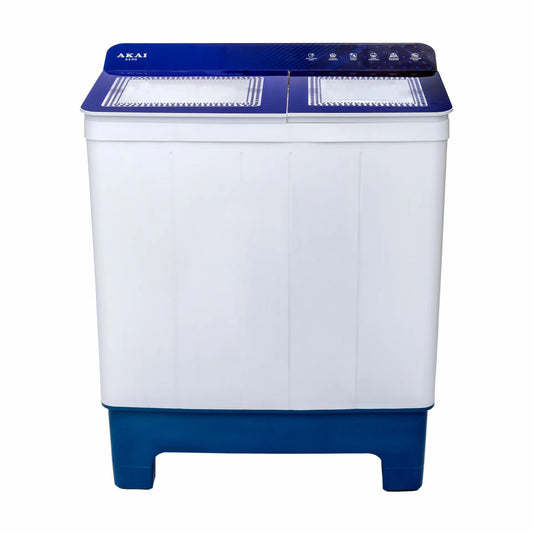
Take Greater Control of Laundry with Our Semi-Automatic Washing Machines
We design our semi-automatic washing machines for customers who prefer direct control over water filling, washing, rinsing and spin extraction. These machines typically use two separate tubs: one for washing and another for spinning. After the wash stage, you transfer clothes manually into the spin tub and operate the required spin cycle.
This extra involvement can be useful where the water supply is irregular or customers want to control how much water they add. It also makes semi-automatic machines a practical option for households seeking a lower purchase price than many fully automatic models.
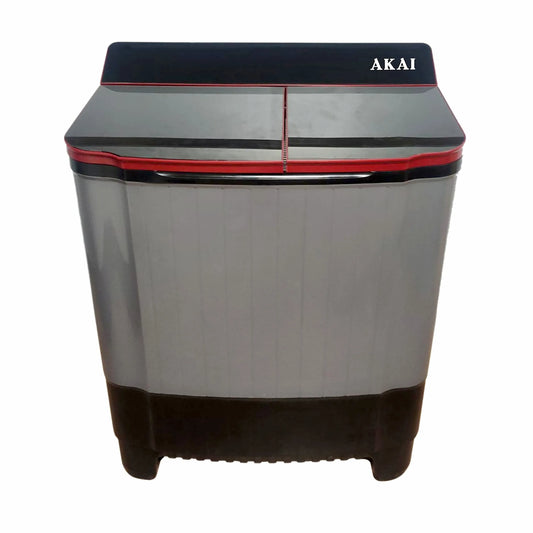
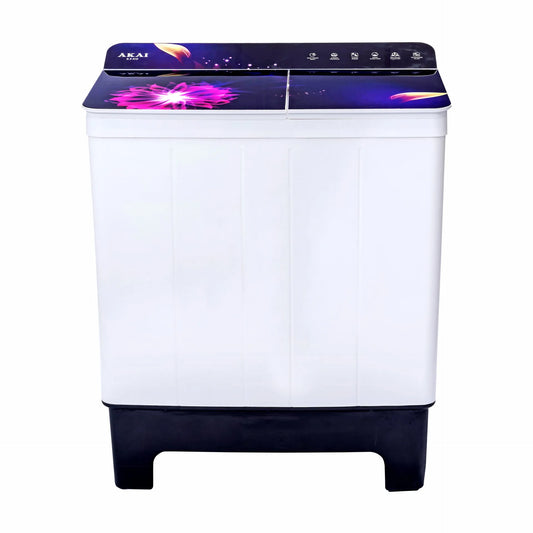
Our live collection covers 8.5 kg, 10.5 kg and 12.5 kg capacities. Most models use a durable plastic body designed to resist body corrosion, while select models are positioned with toughened-glass lids or a stainless-steel wash tub. AKAI semi-automatic washing machine has three wash programmes, Magic Filter, a strong pulsator, low-noise operation, buzzer alerts, castor wheels and thermal motor protection.
Exact features can vary across nine models. We recommend comparing the approved specifications rather than assuming every colour or capacity includes identical lids, tubs, motors and accessories.
Which Capacity Should You Choose?
Choose our 8.5 kg models for regular family laundry
Our 8.5 kg semi-automatic washing machine range is the broadest part of this collection, with six visible variants. It may suit approximately three-to-five-member households, depending on laundry frequency, garment type and bulky items.
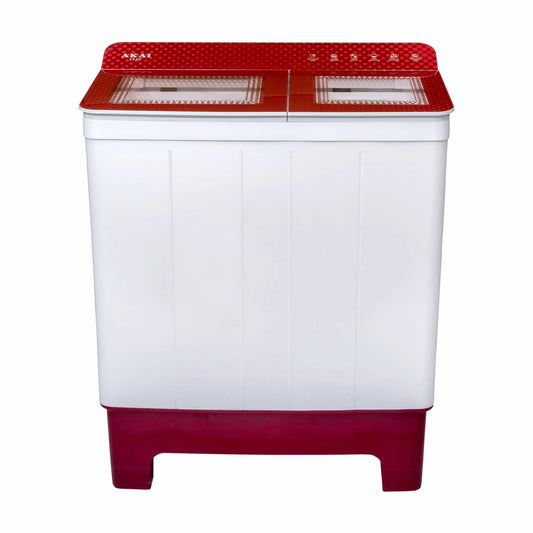
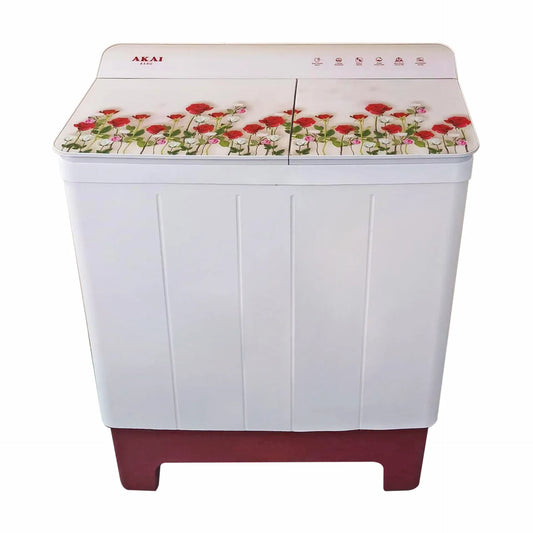
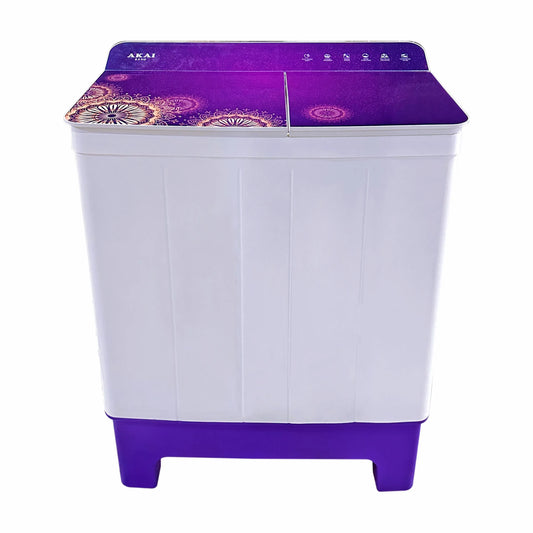
Choose the AKSA-85DGBFG if you prefer the model currently positioned with a toughened-glass lid and Grey finish. Choose the stainless-steel-tub model if tub material is your priority, after verifying whether both wash and spin tubs or only one component use steel. Other Purple, Red, Rose Flower, and Blue options offer different visual designs, but their technical differences should be presented in a comparison table.
Choose our 10.5 kg model for larger weekly loads
Our AKSA-105WGBFG sits between the 8.5 kg range and the largest 12.5 kg models. We recommend it for larger households or customers who regularly wash towels, school clothes and bigger mixed loads but do not need maximum capacity.
Before choosing it, compare the exact dimensions, wash motor, spin motor, RPM, tub material and spin capacity. More wash capacity usually requires more floor space and can make the machine heavier to move.
Choose our 12.5 kg models for high-volume family laundry
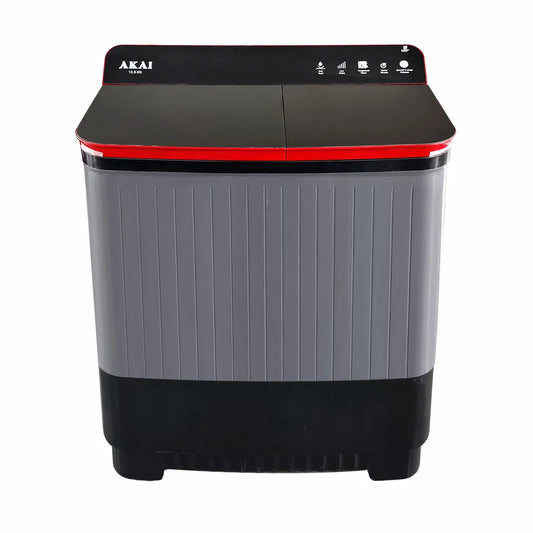
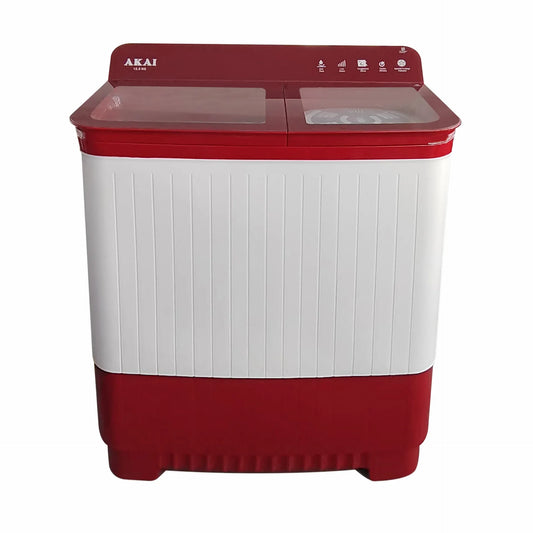
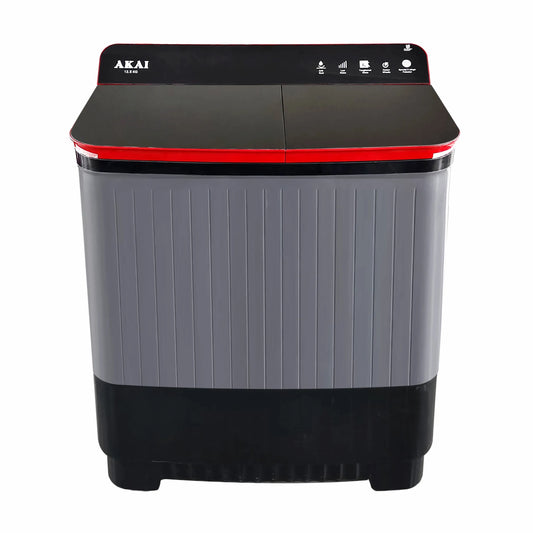
Our 12.5 kg semi-automatic washing machine models are the largest options in this collection. They can suit large families or customers who accumulate substantial laundry between wash days. AKSA-125DGBFG provides a Dark Grey finish, while AKSA-125DRTG provides a Red option.
Akai both 12.5 Kg model has a 5-wing special pulsator, three wash programmes, Magic Filter, plastic body/tub, low-noise operation, buzzer, castor wheels, soft-close toughened-glass lids and thermal motor protection.
Do not select 12.5 kg merely because it is the largest. A bigger wash tub requires more water and space when filled. Households that wash small loads frequently may find 8.5 or 10.5 kg more practical.
Capacity Guide
8.5 kg Capacity
- Practical Starting Household: Approximately 3–5 members
- Suitable Use: Regular clothing, towels, and weekly household laundry
10.5 kg Capacity
- Practical Starting Household: Approximately 4–6 members
- Suitable Use: Larger mixed loads and less frequent wash days
12.5 kg Capacity
- Practical Starting Household: Large households or high laundry volume
- Suitable Use: Heavy family loads and bulky items permitted by the manual
These are general guidelines, not guaranteed load rules. Fabric volume, wash frequency, spin-tub capacity and garment-care labels matter.
Compare Our Model Groups
8.5 kg Models
- Number of Live Models: 6
- Key Decision: Choose based on colour, lid type, tub material, price, and verified feature differences
10.5 kg Models
- Number of Live Models: 1
- Key Decision: Higher capacity without moving to the maximum size
12.5 kg Models
- Number of Live Models: 2
- Key Decision: Maximum capacity with Dark Grey or Red finish options
Use live product cards for price, MRP, discount, EMI and stock. Use individual specification tables for motor, RPM, dimensions, weight, wash programmes and accessories.
What Does Semi-Automatic Mean?
A semi-automatic washing machine completes part of the laundry process through powered wash and spin functions but requires manual involvement. You generally add water, choose the wash timer or programme, drain the wash tub, transfer clothes to the spin tub and control rinse/spin stages.
This is different from a fully automatic machine, which manages washing, rinsing and spin extraction in one tub after programme selection. Semi-automatic does not mean inferior; it means greater manual control and responsibility.
Customers should know this workflow before ordering. The machine will not automatically transfer clothes from one tub to the other.
Semi-Automatic vs Fully Automatic
Choose one of our semi-automatic models when:
- Water supply is irregular or you prefer manual filling;
- Upfront budget matters;
- You want control over water quantity and cycle timing;
- You are comfortable transferring clothes to the spin tub;
- Mobility and straightforward mechanical controls are useful.
Choose one of our fully automatic models when:
- You want a single-tub wash, rinse and spin programme;
- A suitable continuous inlet and drainage setup is available;
- Lower manual handling matters more than upfront price;
- You do not want to transfer wet garments between tubs.
Neither category is universally better. The right choice depends on convenience, water conditions, space, budget and laundry habits.
Why Semi-Automatic Machines Still Make Sense in India
Semi-automatic machines remain relevant where scheduled municipal water, overhead tanks or inconsistent pressure make a continuous automatic inlet less convenient. Users can fill the wash tub according to the programme and local water availability.
They can also offer accessible purchase pricing and relatively simple operation. However, they require more time and physical handling. Customers with mobility limitations should consider whether moving wet clothes between tubs is comfortable.
Water efficiency depends on user behaviour. Manual control can reduce waste when water is measured carefully, but overfilling or repeated rinsing can use more water. We should not make a universal water-saving claim without a defined test.
Strong Pulsator and Wash Action
Our representative pages describe a powerful or five-wing pulsator designed to circulate water through the wash tub. This action helps move garments, detergent and water during the selected programme.
Cleaning performance also depends on load, detergent, water level, stain treatment, wash time and fabric. Avoid compressing too many garments into the tub, because clothes need room to move. We should not promise the removal of every stain.
Treat difficult stains promptly using fabric-safe methods. Follow the garment label and detergent instructions, especially for delicate, printed or coloured clothing.
Magic Filter and Lint Care
Our Magic Filter is designed to collect lint and loose debris during washing. It should be removed and cleaned regularly according to the manual. A clogged filter can reduce effectiveness and may create odour or drainage problems.
Separate high-lint towels from dark or delicate clothing where possible. Empty pockets and turn suitable garments inside out. A filter supports lint management but cannot replace correct sorting.
Plastic Body, Rust Resistance and Tub Materials
Akai semi-automatic models use a plastic outer body, which does not rust like exposed metal. This can be useful in humid laundry areas, but electrical, motor and internal components still require protection from water, impact and pests.
Avoid the absolute claim that the entire washing machine is rust-proof unless every relevant component has been tested. `Rust-resistant plastic body` is more precise.
One 8.5 kg product title states `Stainless Steel Tub`, while representative models describe plastic body and tub. AKAI should specify exactly which tub—wash, spin or both—uses stainless steel. This can become a meaningful comparison factor when documented accurately.
Installation and Placement Checklist
Before ordering, measure the complete installation space and path. Semi-automatic machines need side-to-side room for both lids and enough surrounding access for manual transfer.
You will need:
- a firm, level floor;
- an earthed electrical outlet;
- access to clean water;
- a drainage point at the approved height;
- space to open both lids;
- room to handle wet clothes safely;
- protection from direct rain and uncontrolled splashes.
Avoid unstable extension boards. Keep plug and controls dry. Follow the official installation and safety manual.
Maintenance for Long-Term Use
After washing, drain both tubs and wipe accessible surfaces. Clean the lint filter regularly and leave lids open briefly when safe to release moisture. Remove detergent residue and keep the drain hose clear.
Do not pour water over the control panel. Disconnect power before approved maintenance. Contact authorised support for unusual noise, burning smell, persistent leaking, damaged cables or motor problems.